



 LOCATIONS
What comes to mind when you think about head protection? Price? Design? Compliance with regulations?
When we put that question to workers in a recent workshop, three answers came back consistently: durability, comfort, and quality.
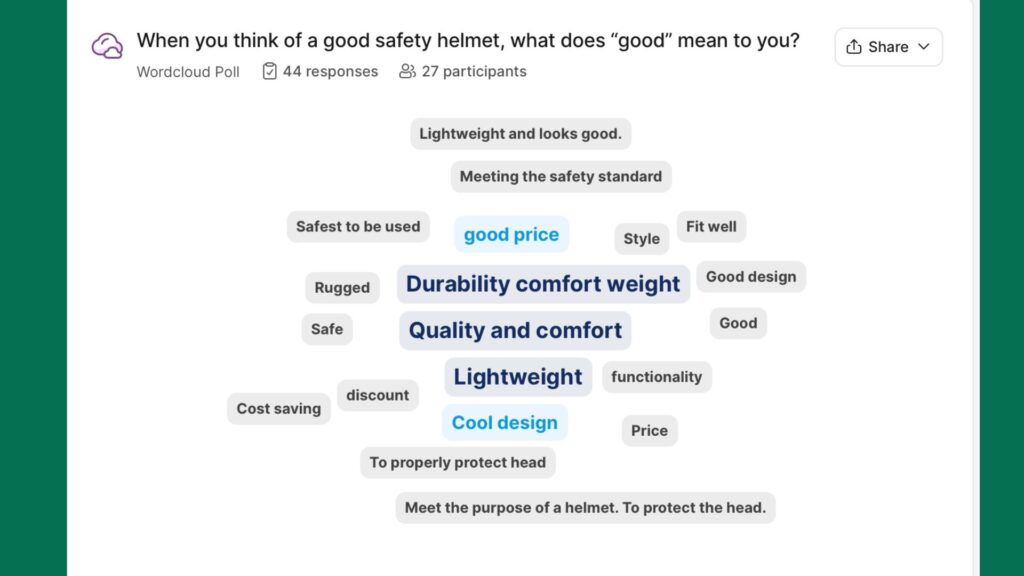
They sound like purchasing criteria. But look closer, and they’re telling us something much more important — that the workers wearing this equipment every day understand intuitively what the data confirms: a helmet that doesn’t get worn isn’t protecting anyone.
Comfort is not a luxury; it’s a compliance issue.
Here’s a number worth sitting with: studies have found that the vast majority of workers who suffered head injuries on the job were not wearing any head protection at the time of the incident — despite being in environments where it was required.
The reasons vary. But discomfort is consistently near the top of the list.
A helmet that causes pressure points, traps heat, or shifts with every movement becomes something a worker tolerates rather than relies on. Over a 10-hour shift in a hot, humid environment, that tolerance has limits. Helmets come off during breaks and don’t go back on. They’re pushed back on the head, compromising the suspension’s ability to manage an impact. They’re abandoned entirely on shorter tasks where “it’s not worth it.”
None of these are failures of discipline. They’re predictable human responses to equipment that wasn’t comfortable enough to wear consistently.
The suspension system is doing more work than you think.
Most workers think of the hard hat shell as the protective element. The suspension system — the internal harness that holds the shell away from the head — is equally critical, and far more directly connected to comfort.
A well-engineered suspension does several things simultaneously: it absorbs and distributes impact energy, maintains the clearance between shell and skull that makes that absorption possible, and keeps the helmet stable across a range of head movements. It also determines how the helmet feels across a full shift.
Ratchet-style suspensions — which allow the wearer to adjust fit without removing the helmet — make proper fitting more likely because they remove the friction of adjustment. A helmet that’s easy to fit correctly gets fitted correctly. One that requires the helmet to come off for every adjustment tends to stay unadjusted.
Fit matters beyond comfort too. Construction helmets should fit securely on the head, with the suspension adjusted to a snug fit. A loose helmet moves on impact, reducing the suspension’s ability to do its job. The clearance between shell and head — typically around 1 to 1.25 inches — must be maintained for the impact management system to function as designed.
Heat is an underestimated variable.
Industrial environments are rarely comfortable. Workers in petrochemical plants, foundries, construction sites, and confined spaces regularly operate in high-heat conditions — and head protection adds to that thermal burden.
Sweat accumulation under a poorly ventilated helmet accelerates fatigue, increases the urge to remove the helmet, and in extreme heat, contributes to heat stress risk. Sweatbands and ventilation channels address this directly — not as comfort features, but as factors that influence how long a worker can realistically wear their helmet without relief.
In high-heat environments, the helmet that stays on longer is the safer helmet — regardless of how its impact ratings compare on paper.
Durability is about performance over time, not just longevity.
When workers say they value durability, they’re expressing something specific: they want to know the helmet protecting them on day 900 is still the helmet they were issued on day one.
That’s a reasonable expectation. It’s also not guaranteed.
Hard hat shells degrade. UV exposure breaks down the polymer structure of the shell over time — often invisibly. A shell that looks intact may have lost meaningful impact resistance. The same applies after any significant impact: if the hard hat has sustained an impact, dispose of it immediately, even if damage is not visible. The energy absorption that protected the worker has already been spent.
A simple field test can indicate shell degradation: compress the shell inward from both sides by about an inch and release. A healthy shell returns quickly to its original shape. One that’s slow to recover, or that shows any cracking, should be removed from service immediately.
The suspension degrades independently of the shell. Straps lose elasticity, headbands stretch, key fittings loosen. Suspension systems should be replaced after 12 months from date of first use — the shell every five years under normal conditions, sooner in environments with higher UV, chemical, or temperature exposure.
These aren’t arbitrary timelines. They’re the intervals at which performance can no longer be assumed.
What to check — and when.
Before every shift:
- Inspect the shell for cracks, dents, or any sign of impact damage
- Check the suspension for frayed straps, loose fittings, or loss of elasticity
- Confirm fit is properly adjusted
- If in doubt, remove from service
Periodically:
- Perform the shell compression test to check for UV degradation
- Record the date of first use — replacement intervals run from use, not manufacture
- Replace suspensions annually regardless of appearance
- Replace shells at five years, or sooner if the environment warrants it
And one rule that’s non-negotiable: never mix suspensions and shells from different manufacturers. Hard hats and suspensions are tested and certified together as a unit. Mixing components voids the certification and undermines the performance the system was designed to deliver. The Bullard hard hat is engineered to have all the necessary safety components function as a complete system for all-round protection.
The full picture.
Selecting the right type of helmet for the task. Verifying that it has been independently tested and certified. Ensuring it fits correctly, stays on through a full shift, and performs as designed for its entire service life.
These are not separate considerations. They are a connected chain — and protection is only as strong as its weakest link.
The workers in our workshop who said comfort, durability, and quality were their top priorities weren’t thinking about product features. They were telling us what it feels like to rely on a piece of equipment every day, in real conditions, for years at a time.
That’s worth listening to.