




 LOCATIONS
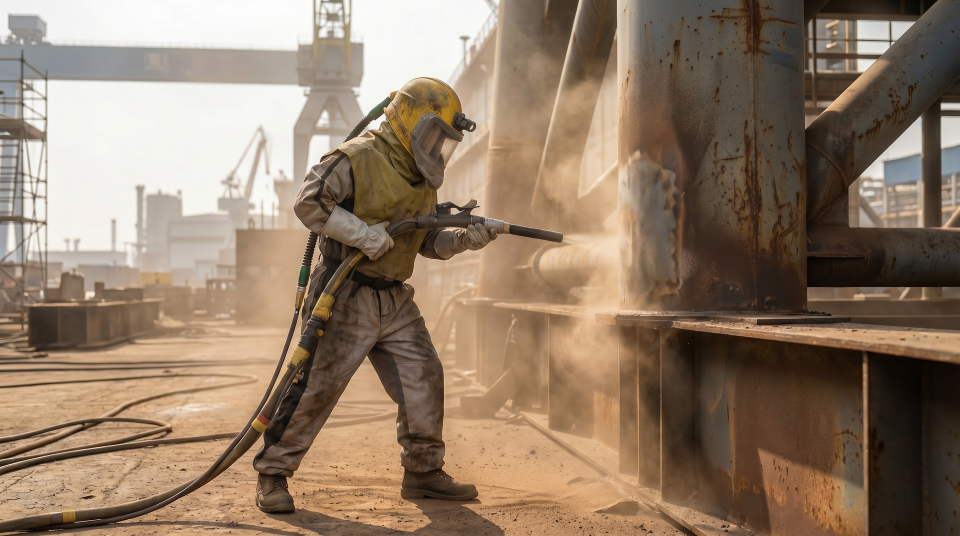
Abrasive blasting is one of the more demanding occupational environments to manage from a health and safety standpoint. The hazard profile is broad — respiratory exposure, impact risk, noise, air quality, carbon monoxide. Controlling it effectively requires a systems approach rather than piecemeal PPE selection.
For HSE professionals managing blasting operations, that checklist is well understood. What sometimes gets less attention is heat. This is not because it’s overlooked as a hazard, but because its effects are gradual and cumulative rather than immediate and obvious.
Heat stress in blasting: the variables worth revisiting
A few factors make abrasive blasting particularly demanding from a thermal stress standpoint.
The sealed helmet environment. A supplied air blasting helmet is protective precisely because it creates a sealed environment around the head and face. But that same seal means heat generated by the body has limited means of escape. Unlike open-face or loose-fitting respirators, a blasting helmet traps heat actively and the effect compounds as a shift progresses.
Physical workload. Blasting is heavy, continuous physical work. Metabolic heat generation is high from the outset, and sustained effort means core body temperature rises faster than in less physically demanding tasks. In occupational heat stress assessment, workload is a primary variable and blasting sits at the demanding end of that spectrum.
Ambient conditions. Many blasting environments are hot by nature. When ambient wet bulb globe temperature is already elevated, the thermal load inside the helmet becomes compounded further.
Shift duration. Heat stress is cumulative. A worker who is managing adequately at hour two may be significantly more compromised by hour five. This is not because conditions have changed, but because physiological reserves have been progressively depleted. This is where PPE compliance tends to quietly deteriorate: visors lifted, collars loosened, breaks taken earlier and more frequently than planned.
Why PPE compliance is part of the heat stress picture
This last point is worth dwelling on. Heat-driven PPE non-compliance is a recognised phenomenon in occupational health — and in blasting environments, it carries direct consequences for respiratory and impact protection, not just thermal comfort. A worker who removes or adjusts their helmet earlier than intended because of heat is no longer protected by the rest of the system.
For HSE managers, this is the compounding risk that heat stress introduces: it doesn’t just affect the worker directly, it undermines the effectiveness of every other control measure in place.
Where cooling fits into the system
This is what shaped Bullard’s approach to the GVX blasting helmet as a configurable supplied air respiratory system. Designed to address the known hazard profile of blasting comprehensively, the system covers respiratory protection, Grade D air delivery, CO monitoring, impact protection, noise attenuation, and visibility — with cooling available as a configuration option because it addresses the variable that affects everything else.
By actively cooling the supplied air before it enters the helmet, the thermal environment inside becomes manageable across a full shift — which means the worker stays more comfortable, PPE gets worn more consistently, and the rest of the system continues to do its job.
It’s not a standalone feature. It’s what keeps the whole system performing as intended.
One blaster at Shell Vito described the difference simply after their first shift with cooling: “Feels like working in the air-con room.”
That’s not a comfort upgrade. That’s the system working the way it should.